What to See Inside Hagia Sophia
What can you actually see inside Hagia Sophia today? From the upper gallery, explore iconic mosaics, hidden details, and what’s changed since 2024 before you visit.
Last updated: April 11, 2026
Pick the details you want to linger over before entering. Audio entry supports an independent gallery visit; a guided walk adds the broader Sultanahmet story. Choose How To Explore The Gallery ↓
Booking Summary: In brief: select the exact ticket option, check child and access requirements, and leave time for security. Blue Mosque admission is free; guidance is optional.
What’s Inside Hagia Sophia: Quick Reference
| The Dome (55.6m high, 31m diameter) | Viewed from upper gallery | Yes, dramatic elevated views |
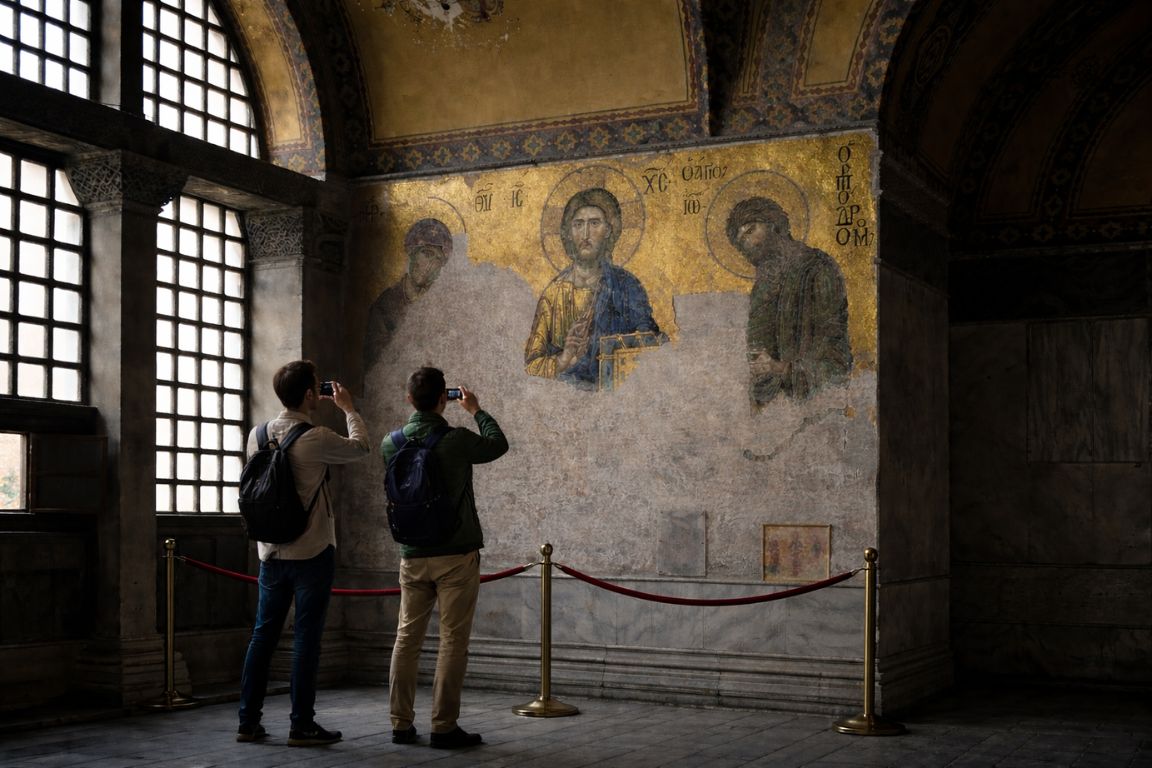
| Deesis Mosaic (c.1261) | South upper gallery | Yes, on tourist route |
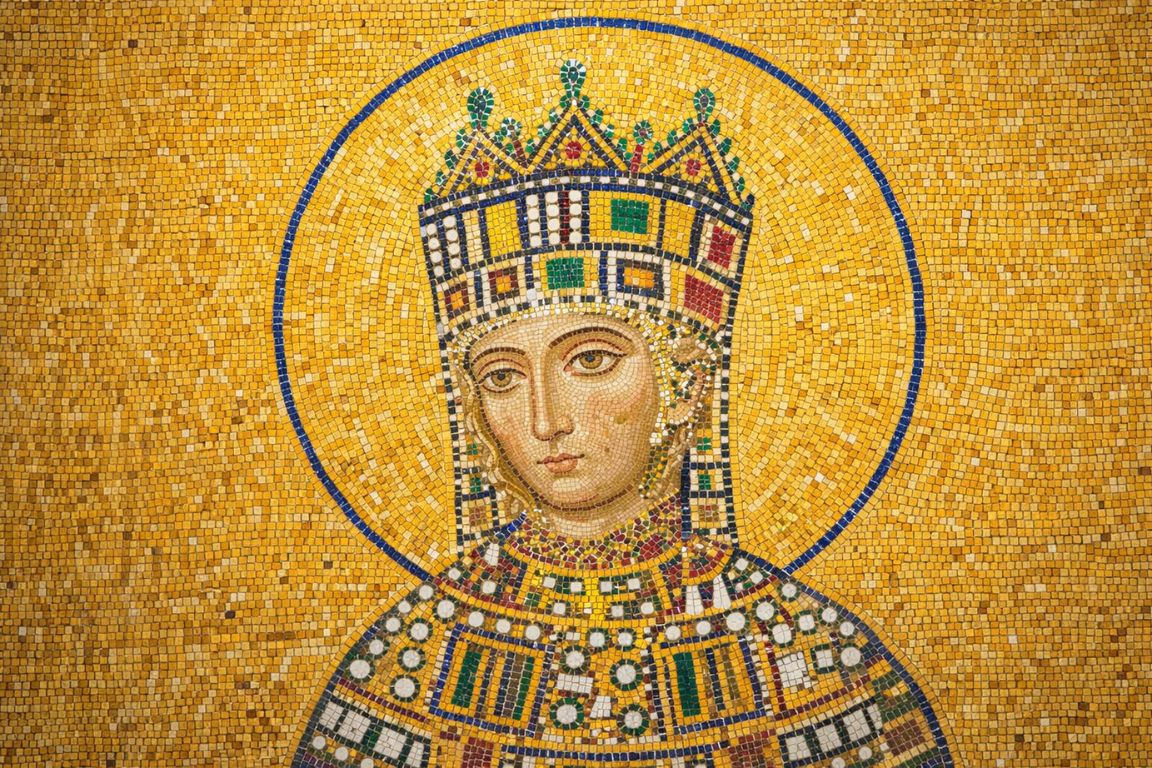
| Empress Zoe Mosaic (11th c.) | East wall, south gallery | Yes, on tourist route |
| Komnenos Mosaic (12th c.) | South gallery | Yes, on tourist route |
| Seraphim Angels on Pendentives | Four dome corners (viewed from gallery) | Yes, one face uncovered; three covered by gold stars |
| Ottoman Calligraphy Medallions (19th c.) | Nave (viewed from gallery above) | Yes, visible from gallery |
| Marble Door (Heaven and Hell Gate) | South gallery | Yes, on tourist route |
| Weeping Column | Northwest corner of gallery | Yes, on tourist route |
| Viking Runic Graffiti | South gallery marble balustrade | Yes, look closely at the railing |
| Tomb of Enrico Dandolo | South gallery floor | Yes, on tourist route |
| Virgin and Child Apse Mosaic (867 AD) | Apse semi-dome (ground floor) | Partially visible from gallery level |
| Mihrab, Minbar, Omphalion | Ground floor (worship area) | Visible from gallery above, not accessible directly |
Pick three details to focus on so a long checklist does not turn the gallery into a rush. Match Your Viewing Style →
What Will You Actually See Inside Hagia Sophia As A Tourist In 2026?
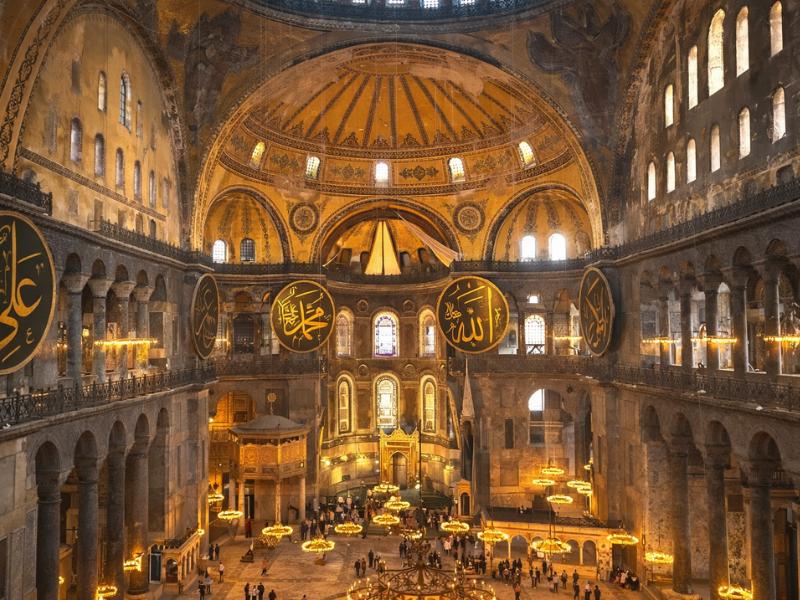
Since January 2024, all tourists follow a single route through the upper gallery only. You enter via a ramp on the northeast side, which deposits you directly into the elevated gallery floor. From there you look down at the nave and active prayer space below, see the dome at close range from the sides, walk the full gallery loop including the south gallery’s mosaics, and exit via another ramp. You do not access the ground floor. The route is one-directional and takes 60 to 90 minutes at a relaxed pace.
This is the single most important thing to understand before you arrive. Dozens of older articles still describe wandering the nave, standing beneath the dome at floor level, and exploring the full interior freely. That experience has not been available to tourists since 2020, and since January 2024 the tourist route has been further formalized into the upper gallery only. More than half of first-time visitors in 2024 and 2025 reported being surprised by this on arrival.
What you lose in ground-floor access, you genuinely gain in perspective. The upper gallery is where the art lives. The most important Byzantine mosaics, the Deesis, the Empress Zoe panel, the Komnenos family portrait, are all in the south gallery. The Viking graffiti is up here. So is the Weeping Column. The dome looks different from gallery height than from the floor; you’re closer to it, and the light from its 40 windows hits the space at angles that change through the morning and afternoon.
As of early 2026, structural restoration scaffolding is visible inside the nave. Four main vertical supports extend toward the dome from the central floor area. Based on traveler reports and photographs from the gallery level, the scaffolding does not obstruct the major mosaics or block significant views from the gallery railing. It is visible and worth knowing about in advance so it doesn’t come as a surprise.
Knowing what to look for changes everything about this visit. The practical way to use this article on site is a guided tour with a licensed guide and fast entry.
We’ve put together a full visitor breakdown on how to visit Hagia Sophia tours so you know exactly what to expect from entry to exit including the areas most tourists completely miss.
The entry option names upper-gallery access. It does not include the prayer area downstairs. Choose The Gallery Ticket →
What Makes The Dome Of Hagia Sophia So Extraordinary?
The dome spans 31 meters in diameter and rises 55.6 meters above the floor. It sits on four curved triangular pendentives, a structural solution that had never been applied at this scale before 537 AD. Forty windows ring the base of the dome, creating the illusion that it floats on a halo of light rather than resting on masonry. The 6th-century historian Procopius wrote that the dome seemed “not to rest upon solid masonry, but to be suspended from heaven by a golden chain.” The dome partially collapsed after earthquakes in 553 and 557 AD and was rebuilt higher and steeper by Isidore the Younger.
Standing in the gallery and looking up at the dome, the first thing most people feel is a kind of cognitive disorientation. The scale is larger than the eye expects from photographs. And then, slowly, the question forms: how does this stay up? For Byzantine engineers, it was exactly the right question. The solution they found, the pendentive, was a curved triangular section that transitions from a square base to a circular dome. It sounds simple. It had never been done at this scale before. The closest predecessors used round or octagonal bases. Putting a dome this size on a square nave was unprecedented.
The pendentives are the four triangular curved sections visible in the corners below the dome. They carry the dome’s load down to four massive piers through a system of arches, half-domes on the east and west sides, and later Ottoman buttresses added by Mimar Sinan in the 16th century after the building showed signs of structural fatigue. Sinan understood the building well enough to strengthen it without altering its visual character. The buttresses are visible on the exterior and are part of why the building is still standing after 15 centuries and multiple major earthquakes on the North Anatolian Fault.
The 40 windows at the dome’s base are not decorative. They serve the structural purpose of reducing weight at the transition zone, and they produce the famous lighting effect: on clear mornings, the light arrives in 40 distinct shafts that make the dome appear to hover. The effect is most pronounced between 09:00 and 11:00 in summer. Late afternoon creates a warmer, golden quality as the light enters from the west. Both are worth experiencing. Neither can be fully reproduced in a photograph.
The dome has four six-winged Seraphim angels on the pendentives, part of the original Byzantine visual program. Their faces were covered with golden eight-pointed stars during the Ottoman period, in accordance with Islamic tradition against representational images. In 2009, one face was restored and uncovered for the first time in 400 years. The other three remain covered. From the gallery, you can see the angels’ wings clearly. The uncovered face is on the southeast pendentive.
Want the main dome to yourself for at least a few minutes? Our best time to visit Hagia Sophia tours guide covers the early morning windows, off-season advantages, and exactly which days of the week see the lightest foot traffic.
Look at the supports as well as the dome; weather and restoration can affect the view. Read The Architecture Timeline →
What Are The Most Important Byzantine Mosaics In Hagia Sophia?
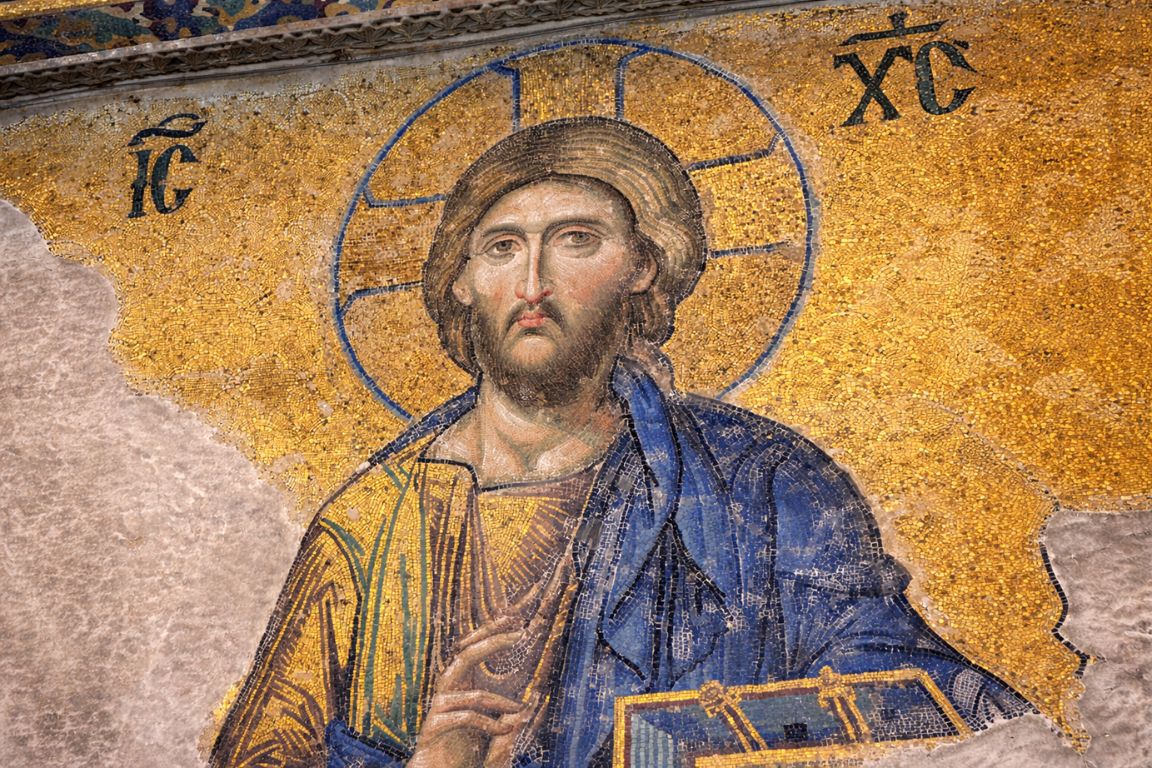 Three mosaics are on the current tourist route in the south upper gallery: the Deesis (c.1261), the Empress Zoe Mosaic (11th century), and the Komnenos Family Mosaic (12th century). The Deesis is widely considered the finest mosaic in the building and a precursor to Renaissance naturalism. The Virgin and Child in the apse semi-dome (867 AD) is partially visible from the gallery. The Emperor Leo VI mosaic above the Imperial Gate is off the tourist route and currently inaccessible.
The Deesis is where most visitors pause longest, and for good reason. Dating to around 1261, it shows Christ Pantocrator flanked by the Virgin Mary and John the Baptist, both turning toward him with expressions that Byzantine art rarely attempts: genuine human sorrow and urgency. Mary and John are not triumphant here. They are pleading, interceding for humanity on the Day of Judgment. Their faces carry weight. Christ’s expression manages to hold both absolute authority and something harder to name, something almost resigned.
Scholars consider the Deesis a pivot point in Byzantine art toward the naturalistic style that would define the Renaissance in Italy a century later. You can see it in the treatment of the faces. The gold background is Byzantine in convention, but the human expressiveness breaks from the hieratic tradition. Standing in front of it quietly for five minutes rather than passing in the group flow is genuinely different from a quick glance. The lower portion is badly deteriorated, but the surviving faces are intact and extraordinary.
The Empress Zoe Mosaic has an extraordinary backstory most visitors don’t know. Empress Zoe, who ruled Byzantium in the 11th century, was married three times. The mosaic originally showed her first husband, Romanos III. When she remarried, his face was replaced. When she married again, that face was replaced too. The current face belongs to Constantine IX Monomachus, her third husband. If you look closely at the inscription above the male figure, you can still see traces of alteration in the tiles. This is a portrait that was literally edited twice in gold tesserae, and it shows.
The Komnenos Mosaic, also in the south gallery, shows Emperor John II Komnenos and his wife Empress Eirene flanking a full-frontal Christ, with their son Alexios in a panel around the corner. Eirene of Hungary was noted for her personal piety, and her mosaic portrait is unusual for its naturalness. The family grouping reflects the close link between imperial power and divine legitimacy that runs through Byzantine visual culture.
| Deesis | c.1261 | Christ, Virgin Mary, John the Baptist | On tourist route |
| Empress Zoe | 11th century | Christ enthroned with Empress Zoe and Constantine IX | On tourist route |
| Komnenos | 12th century | Emperor John II, Empress Eirene, Christ | On tourist route |
| Virgin and Child (Apse) | 867 AD | Virgin Mary seated with Christ child | Partially visible from gallery; veiled at prayer times |
| Emperor Leo VI | 10th century | Emperor prostrate before Christ | Off tourist route – not accessible |
| Seraphim Angels | 14th century | Six-winged angels on pendentives | Visible from gallery; one face uncovered, three covered |
Explore at your own pace
Hagia Sophia gallery entry
Gallery entry · Smartphone audio
Which faces will you find in the Byzantine mosaics?Explore the gallery with smartphone audio and pause at the Deesis, Zoe and Komnenos panels.
Discover the Hagia Sophia Gallery →What Islamic Elements Were Added After The Ottoman Conquest?
After Sultan Mehmed II converted Hagia Sophia into a mosque in 1453, several key Islamic elements were added over the following centuries: a mihrab (prayer niche aligned with Mecca), a minbar (pulpit for Friday sermons), four minarets added at different periods, and eight enormous calligraphy medallions hung in the nave in the 19th century. The mihrab is slightly offset from the building’s original east-west axis to point toward Mecca. The medallions, each 7.5 meters in diameter, bear the names of Allah, the Prophet Muhammad, the first four caliphs, and Muhammad’s two grandsons. They were so large when the building became a museum in 1935 that they couldn’t fit through the doors – so they stayed.
The calligraphy medallions are among the most striking visual elements in the building for a specific reason: they were designed to work within the Byzantine space, not to override it. Created by master calligrapher Kazasker Mustafa İzzet Efendi in the 19th century during the restoration overseen by the Fossati brothers, the medallions hang between the building’s columns with a precision that matches the Byzantine proportional system. They are not foreign to the space. They belong to it.
From the upper gallery, you look down at them and understand their scale in a way you can’t from the floor. Each one is larger than most people are tall, eight times over. The gold calligraphy on the dark green and black grounds is designed to be legible from this height. When the building was functioning as a mosque without tourists, worshippers below would read the names as they prayed. The medallions were a visual complement to the prayer, not just decoration.
The mihrab is directly below in the apse, slightly off-center from the building’s original axis. This offset is deliberate: Mecca lies roughly to the southeast of Istanbul, not due east, so the mihrab points in that direction rather than aligning with Hagia Sophia’s original east-facing apse. You can see it from the gallery rail. The minbar, added under Sultan Murad III in the late 16th century, stands to the right of the mihrab, its carved marble staircase visible from above.
The four minarets were added at different times and by different sultans, which is why they differ in style and material. The southeast minaret, the oldest, is red brick and attributed to Mehmed II or his successor Bayezid II. The northeast minaret is limestone. The two western minarets are identical and were added by Mimar Sinan under Sultan Murad III. Four minarets was a distinction reserved for imperial mosques. No other building was allowed to match it during the Ottoman period.
Recommended tours for this visit
Hagia Sophia Skip-the-Line Entry Ticket
Skip-the-line entry for the current tourist route. Listed duration is one hour.
Hagia Sophia Guided Tour with Licensed Guide & Fast Entry
A licensed guide and fast entry on the current gallery route. Listed duration is one hour.
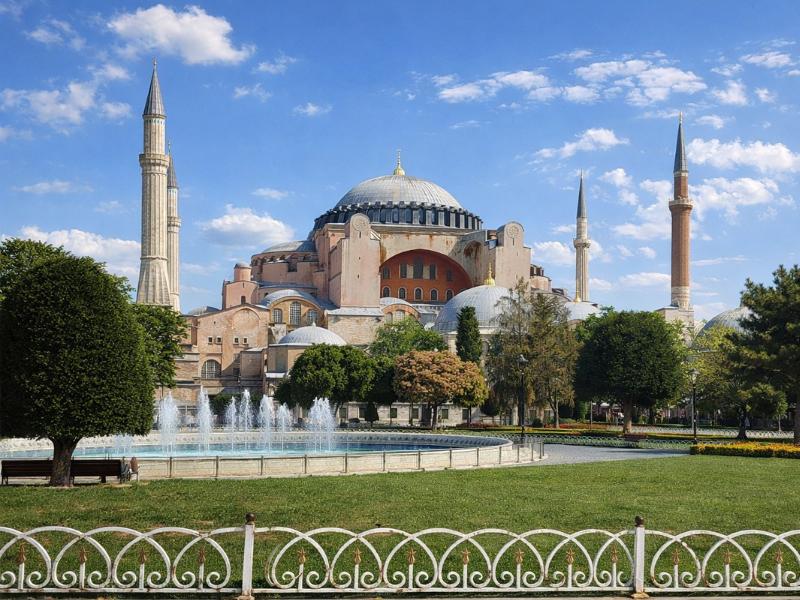
Exclusive Private Hagia Sophia Tour – Skip the Ticket Line
Private Hagia Sophia tour with skip-the-ticket-line entry on the current visitor route.
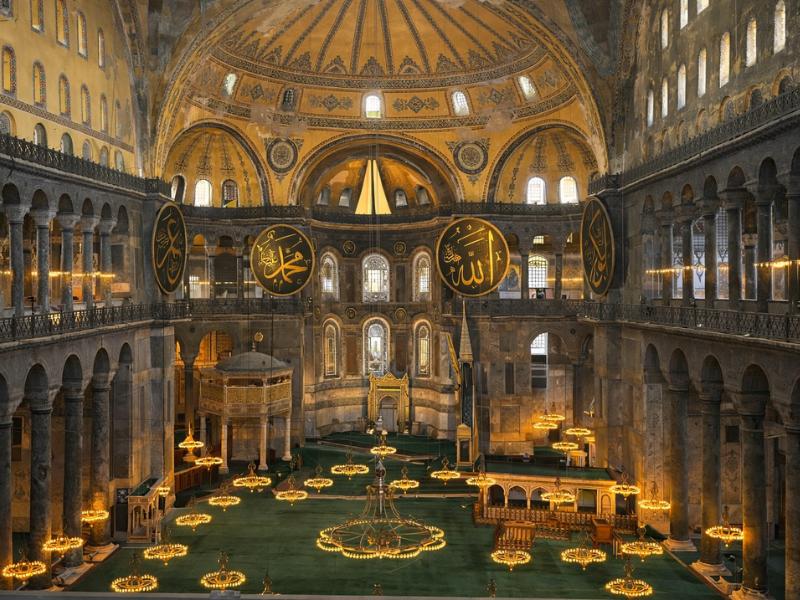
Istanbul Hagia Sophia Group Tour: Skip the Line & Expert Guide
Group tour with skip-the-line entry and an expert guide on the current tourist route.
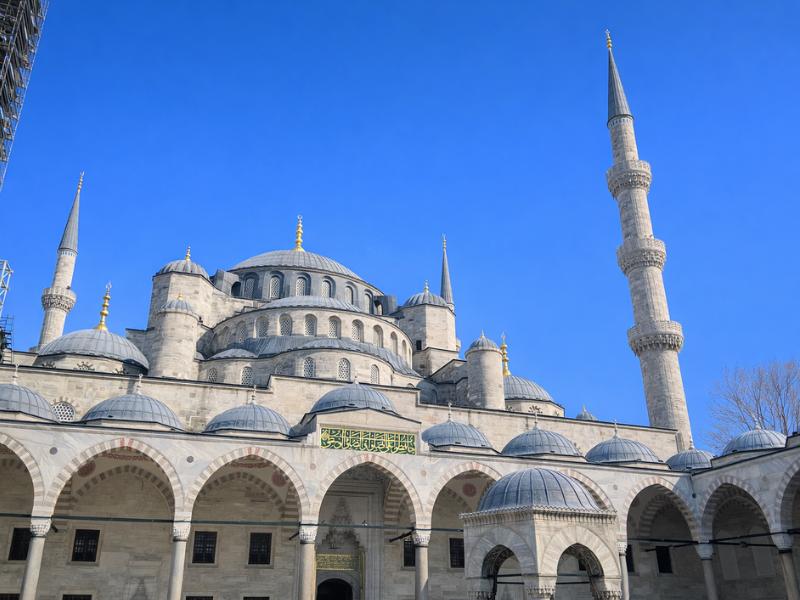
Connect the two mosques
Two mosques & Old Town walk
2.5–3 hours · English guided walk
Ready to connect the Christian and Ottoman layers?Discover the wider story on a guided walk linking Hagia Sophia with the Blue Mosque and the Hippodrome.
Check Dates for the Two-Mosque Walk →What Are The Hidden And Overlooked Details Most Visitors Miss?
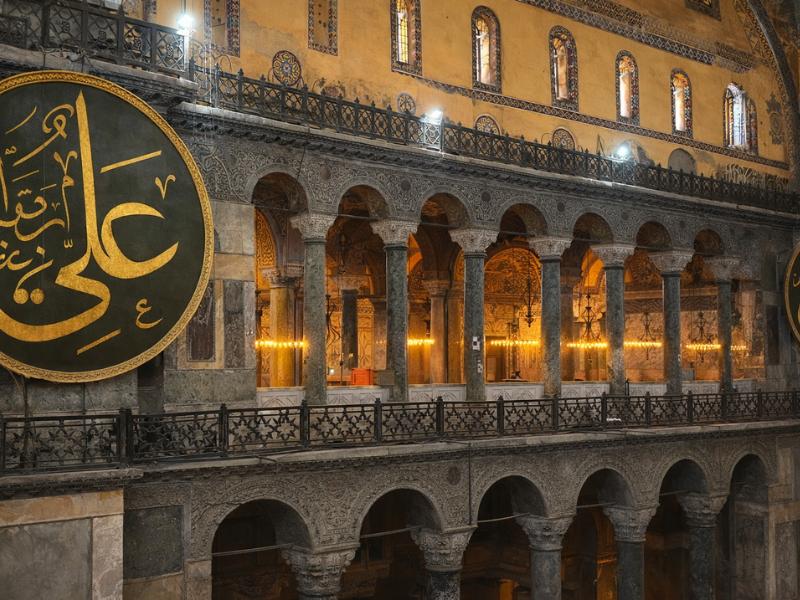
Most visitors focus on the major mosaics and miss several details that are equally worth finding: the Viking runic graffiti on the south gallery balustrade, the tomb marker of Enrico Dandolo (the Venetian doge who sacked Constantinople in 1204) on the gallery floor, the Weeping Column’s bronze-plated hole in the northwest corner, the single uncovered Seraphim face on the southeast pendentive, and the Omphalion coronation floor medallion visible from the gallery far below. None of these are on the audio guide’s main path and most require knowing they exist in advance.
The Viking graffiti is the one that surprises people most consistently. Scratched into the marble balustrade of the south gallery in the 9th century, it reads in Younger Futhark runes: “Halfdan was here.” A second inscription nearby contains the name Ári or Árni. These were members of the Varangian Guard, the Norse mercenary regiment that served Byzantine emperors as personal bodyguards from the 9th to 14th centuries. The graffiti was not vandalism in the conventional sense. It was a practice common among Norsemen marking the furthest extent of their travels. Standing at the same railing and finding the inscription requires knowing roughly where to look on the south balustrade – not at the mosaics, but at the marble itself.
Enrico Dandolo’s tomb marker is a plain stone slab on the gallery floor marked with his name. He was the Doge of Venice who, at 97 years old and reportedly blind, led the Fourth Crusade that sacked Constantinople in 1204. His forces looted Hagia Sophia, including mosaics that ended up in Venice. He died in Constantinople in 1205 and was buried inside the building. The Ottomans later destroyed his original tomb. What you see today is considered to be near the original location. Standing over it, you are standing over the man who did more damage to this building than anyone else in its history, buried inside the building he helped ransack.
The Weeping Column is in the northwest corner of the gallery. A bronze plate surrounds a worn hole in the white marble. The column stays damp even in summer heat, a phenomenon attributed to condensation but dressed in legend: Emperor Justinian reportedly cured a headache by leaning against it, and the moisture is said to be the tears of the Virgin Mary. The ritual is to press your thumb into the hole and rotate it. If your thumb emerges wet, the wish will be granted. After twelve hundred years of thumbs, the marble around the hole is polished smooth.
The Omphalion is on the ground floor, directly below the dome, and is not accessible to tourists. But you can look down at it from the gallery rail. It is an 18th-century description of its purpose: a circular decorative marble medallion, roughly 18.5 feet across, composed of 30 interlocking circles of different colored stone. According to a 13th-century account by Russian Archbishop Antony of Novgorod, Byzantine emperors were crowned at this spot. It was covered by carpet during the Ottoman period and only uncovered when Hagia Sophia became a museum in 1935. From the gallery, it’s the compass point of the whole building.
Wondering whether a self-guided visit leaves you staring at walls without context or whether a guide just slows you down? This guided vs self-guided visit to Hagia Sophia tours covers what first-timers consistently get wrong about both approaches.
Carry a short gallery checklist for the runes, imperial panels and Dandolo marker; follow signs for current access. Read The Historical Context →
How Do You Navigate The Upper Gallery Visitor Route?
 The tourist route is one-directional and does not allow backtracking. You enter through the northeast ramp, which takes you up to the gallery floor. The route proceeds along the gallery, through the south gallery where the mosaics are, through the Marble Door, and exits via a ramp on the northeast side. The full walk, stopping at major points, takes 60 to 90 minutes. The gallery runs in a U-shape around three sides of the nave. Exit is not back through the entrance – you come out a different door than you went in.
The ramp entrance is accessible-style, wide enough for most mobility needs, though the official guidance notes the route is not suitable for wheelchairs without assistance. There are no elevators on the tourist path. Stairs appear at a few transitions within the south gallery. Baby strollers need to be carried and are not recommended.
Once inside the gallery, the route takes you first to the gallery railing overlooking the nave. This is where the dome is closest and the view down to the floor is most dramatic. The calligraphy medallions are visible below. The Seraphim angels are at the corners of the dome at roughly eye level when you’re in the gallery. Take time here before moving on.
The south gallery is the heart of the route. You’ll pass the Deesis first, then the Empress Zoe and Komnenos mosaics. After the mosaics, the path leads through the Marble Door, also called the Heaven and Hell Gate, a heavy Byzantine portal carved from marble. Just past it, on the gallery balustrade, look for the Viking graffiti. The Dandolo tomb marker is on the floor of the south gallery near the Deesis. The Weeping Column is in the northwest section.
One useful tip we pass along to every group: don’t rush the Deesis. Most visitors spend 90 seconds in front of it as the group moves. If you arrive early in the morning on a weekday, the gallery is quiet enough to stop, step back from the balustrade, and look at it without an elbow in your side. The faces in that mosaic were painted to be read at distance. They were not designed to be glimpsed in a crowd.
These details are easier to find with an expert guide on a skip-the-line group tour. If you want that context before you walk up the ramp, start with the private Hagia Sophia tour with skip-the-ticket-line entry.
Ramps do not establish wheelchair suitability. The entry listing excludes wheelchair users, so confirm alternative arrangements before booking. Review Access Needs →
What Is The Difference Between What You Can See Now Vs. Before 2024?
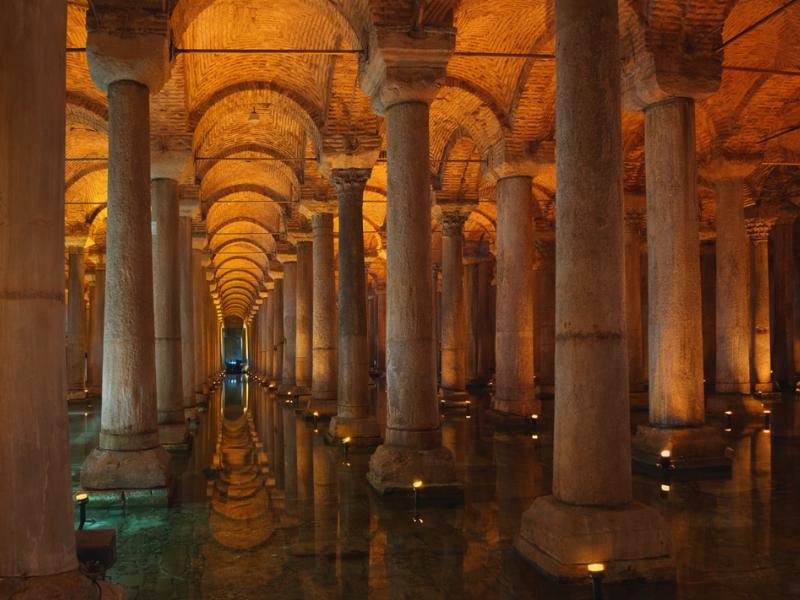
Before January 2024, tourists entered through the main Sultanahmet Square entrance, accessed the ground floor freely, walked through the nave under the dome, stood at the Omphalion, viewed the mihrab and minbar up close, and could also go up to the gallery. Since January 2024, tourists are restricted to the upper gallery only, entering through a new northeast entrance. The ground floor is now exclusively for worship. The Emperor Leo VI mosaic above the Imperial Gate and the tympanum mosaics of church fathers on the north wall are no longer on the tourist route.
The loss of ground-floor access is significant. Standing under the dome at floor level, directly on the Omphalion, looking straight up 55 meters at the dome’s windows while the light comes through in 40 distinct beams, is a different physical experience from viewing the dome from the gallery. At floor level, the dome feels physically impossible in a way that doesn’t fully translate from the gallery angle. That experience is no longer available to tourists.
What the new route does offer in exchange is the gallery’s vantage point, which was always considered the best place for the mosaics and which provides views of the overall interior proportion that the floor-level experience didn’t allow. Byzantine architects designed the galleries for the empress and nobility who attended services. They were meant to be the privileged viewpoint. The current tourist route puts every visitor in that elevated position.
Several mosaics that were accessible before are now off the tourist path. The Emperor Leo VI prostration mosaic, above the Imperial Gate in the inner narthex, is not accessible. The tympanum mosaics of church fathers in the north gallery, once photographed from ground level, are now too far from the tourist route to see properly. The Virgin and Child in the apse semi-dome is partially visible from the gallery but is sometimes veiled during prayer times.
Book for the current visitor-gallery route rather than expecting the old museum floor plan. Choose Current Gallery Access →
What Should You Look For To Make The Most Of Your Visit?
 Five specific things that reward attention: the uncovered Seraphim face on the southeast pendentive (look for the one corner where the six-winged angel has a human face visible rather than a gold star covering); the alteration marks in the Empress Zoe mosaic where the male figure’s face was replaced twice; the floor plan visible from the gallery showing the full proportional system of the building; the lighting change as you move from the north to south gallery as the windows shift position; and the way the Ottoman calligraphy medallions are positioned to align visually with the Byzantine columns below them.
Most visitors look at individual objects. The building rewards looking at relationships. The Seraphim at the dome corners were positioned to guard the original Christ Pantocrator mosaic that once filled the dome’s crown. That mosaic is gone, covered during the Ottoman period, but the Seraphim remain at their stations. Understanding that the angels are still guarding something that’s no longer there adds a layer of meaning to what you’re seeing.
The Empress Zoe mosaic’s facial alterations are subtle but visible. The tesserae in the center of the male figure’s face have a slightly different density and color match from the surrounding tiles. The inscription above was also changed. For a court portrait commissioned to last forever, this one was revised for pragmatic political reasons three times in less than a decade. It is one of the most human details in the building.
Light timing matters more in this building than almost anywhere else. The dome’s 40 windows create different effects by the hour. At opening, the east windows catch direct morning sun and throw light across the gallery floor in distinct shafts. Mid-morning, the whole interior brightens. Late afternoon, the western windows bring a warmer, lower-angle light that makes the gold mosaic tesserae in the Deesis glow in a way they don’t at noon. If you can choose your visit time, early morning and late afternoon both have something midday does not.
Finally: look up at the pendentives and try to find all four Seraphim. Three have their faces hidden behind gold stars. One, on the southeast corner, has its face uncovered, revealed in 2009 after being hidden for 400 years. The four figures are positioned symmetrically around the dome’s base, each one with six wings: two raised, two covering the feet, and in Byzantine iconography two more that would have covered the face. The uncovered one stares directly outward. Its expression is calm and absolute. It is the most recently rediscovered face in a building full of ancient ones.
Choose the detail you most want time with, then decide whether you prefer audio or a wider guided itinerary. Choose Your Viewing Format →
Practical Planning Points For Your Visit
| Found the Viking graffiti without being pointed to it | Almost no one finds it unaided – it requires knowing where to look on the marble |
| Spent 5+ minutes at the Deesis mosaic | Guided groups consistently spend longer here; self-guided groups move through in under 2 minutes |
| Noticed the altered faces in the Empress Zoe mosaic | This detail is invisible without context; transforms the mosaic once you know what to look for |
| Looked for the uncovered Seraphim face | One of the most under-discussed details in the building; nearly unknown to self-guided visitors |
| Visited the free Sultan Tombs after the gallery exit | Among the finest Iznik tilework in Istanbul, free of charge, two minutes from the exit – consistently missed |
Use the named details as your own checklist; do not treat visitor percentages as a promise about what you will see. Build Your Gallery Priorities →
Frequently Asked Questions
Can you see the ground floor inside Hagia Sophia?
Not directly. Since January 2024, tourists access only the upper gallery. You can look down at the ground floor from the gallery railing, including the active prayer area, the calligraphy medallions, and the mihrab. But you cannot walk on the ground floor or stand under the dome at floor level.
Keep gallery sightseeing and prayer-floor access separate in your expectations. Read Current Ticket Inclusions →
Is the Deesis mosaic still accessible in 2026?
Yes. The Deesis is in the south gallery on the current tourist route and remains fully accessible with your €25 ticket. It is not covered or restricted.
The entry listing includes the visitor gallery, but restoration can affect individual views. Choose Gallery Entry →
Where exactly is the Viking graffiti?
On the marble balustrade of the south gallery, after you pass through the Marble Door. The most legible inscription, reading “Halvdan” in Younger Futhark runes, is on the center section of the south railing. It’s small and worn. Look at the marble itself, not the mosaics.
Use the gallery landmarks and current signs to find the small details. Read The Historical Context →
What is the Weeping Column and where is it?
It is a marble column in the northwest section of the gallery with a bronze-plated hole. The column stays perpetually damp due to condensation. The legend holds that pressing your thumb into the hole and rotating it will grant a wish. It was here when Justinian built the church in 537 AD.
Follow current on-site access signs; a ticket does not promise access to every named feature. Review Visitor-Route Expectations →
Are the Byzantine mosaics still visible or have they been covered since the mosque reconversion?
The major mosaics in the upper gallery, including the Deesis, Empress Zoe, and Komnenos panels, remain visible and are on the tourist route. Some ground-floor mosaics are occasionally veiled during prayer. The Virgin and Child in the apse is partially visible from the gallery. The situation is confirmed as of April 2026.
Confirm any feature that is essential to your visit before purchasing. Review What To Ask →
What is the best time of day to see the dome’s famous light effect?
Early morning, between 09:00 and 11:00 in summer (08:00 opening). The 40 windows at the dome’s base catch direct morning light from the east, creating the famous effect where the dome appears to float on a ring of light. Late afternoon after 17:00 produces a warmer, golden quality from the west-facing windows.
Every detail in this building rewards the visitor who knows what they’re looking for.
The Viking graffiti, the altered faces in the Empress Zoe mosaic, the uncovered Seraphim, the Dandolo tomb. None of these are obvious. All of them change the experience of the visit. Compare current Hagia Sophia tours.
No booking guarantees access to every feature during restoration. Confirm the current route and selected ticket. Review Before Booking →
No product guarantees a light effect. Choose your date and leave time for changing conditions. Plan Your Timing →